

THE ALTERNATIVE VIEW:
$10 Trillion in Retirement Assets are Opening to Alternatives: What Advisors Must Do Now
The Next Wave in Democratization
By Rick Lake, CAIA, CETF, CBDA | Founder, Narrative Alpha
September 9, 2025
An Alternative Investment Wake-Up Call
Clients are about to face a significant change: the White House is moving to open 401(k) plans to alternative investments.
Private markets, real estate, even digital assets – all moving from Wall Street to workplace retirement accounts. That’s not just a policy shift. It’s a wake-up call. And one that puts advisors squarely at the center of the conversation.
Recently, the White House issued an Executive Order titled:
“Democratizing Access to Alternative Assets for 401(k) Investors”
The order establishes an ambitious policy goal: improve the net risk-adjusted returns across more than $10 trillion held by 90 million participants in ERISA-regulated defined contribution plans.
For advisors, the challenge is clear. Millions of retirement savers may soon have access to alternatives for the first time. Advisors will be expected not only to explain what these strategies are, but also to help clients understand how they fit into long-term retirement planning. And once that dialogue begins, it won’t stop at the 401(k). The conversation will naturally expand to include how alternatives should be managed across all of a client’s assets.
“Clients are about to face a significant change: the White House is moving to open 401(k) plans to alternative investments.”
Policy Objective: Better Outcomes for Savers
At its core, the Executive Order aims to give everyday savers access to the same investment tools long used by large institutional plans – like pension funds. The goal? Better risk-adjusted returns, broader diversification, and ultimately, stronger outcomes for retirement. By bringing private markets and alternative strategies into defined contribution (DC) plans, policymakers hope to help participants build larger nest eggs over time – while smoothing the investment ride along the way.
“An ambitious policy goal: improve net risk-adjusted returns across more than $10 trillion in defined contribution plans.”
What’s Happening – and Why it Matters
A new Executive Order from the White House pushes regulators to give 401(k) investors more access to key alternative assets – including private markets, real estate, digital assets (through managed funds only), commodities, infrastructure, and lifetime income options.
But this isn’t an open invitation for anything-goes investing. The order emphasizes fiduciary duty, appropriate vehicles, and professional management. The Department of Labor (DOL), Treasury, and the SEC have been given a six-month deadline – until February 3, 2026 – to draft the rules that make this happen.
From Wall Street to Main Street: Bringing Institutional Tools to DC Savers
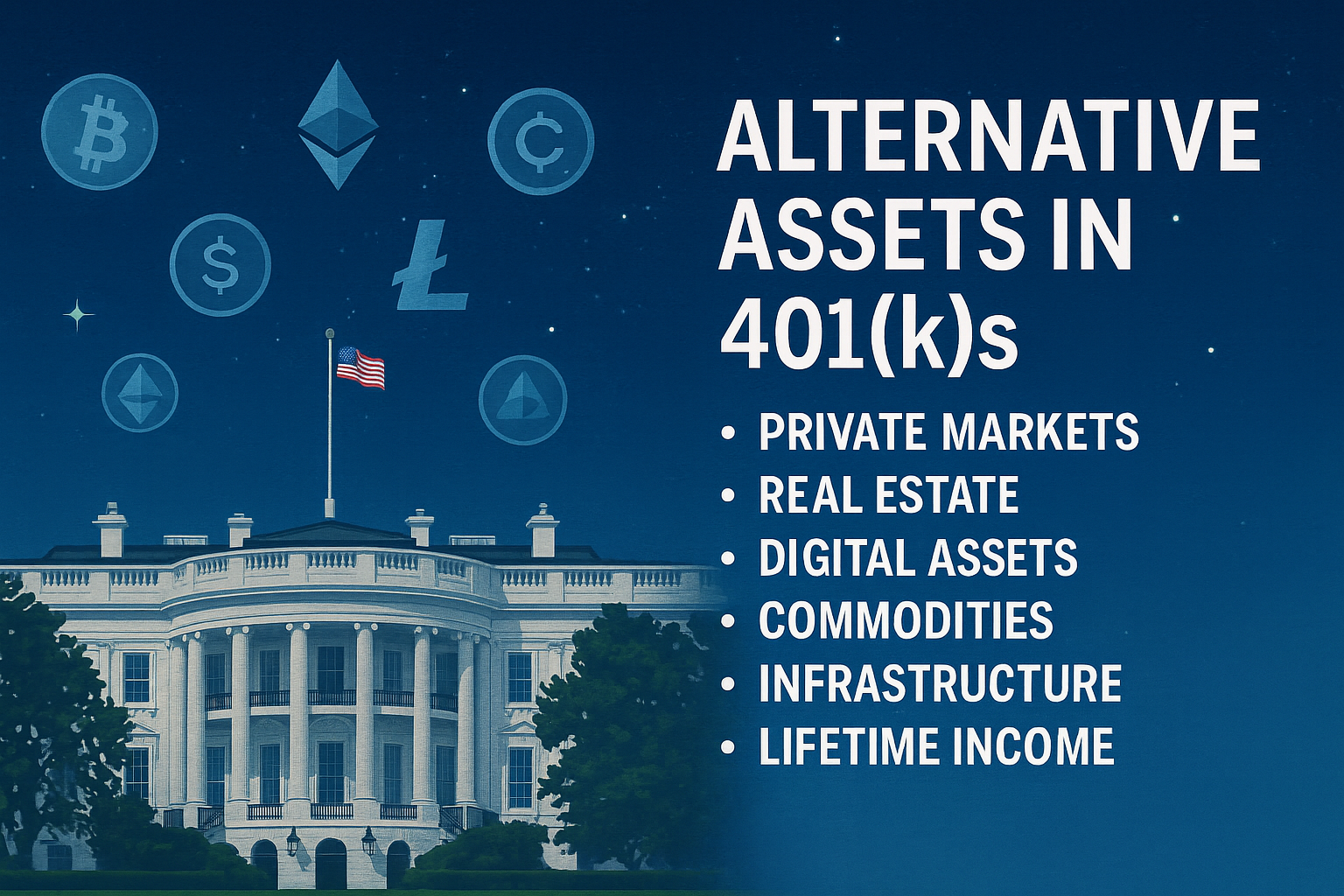
The White House directive aims to bring the powerful diversification tools long used by large pension plans into the retirement accounts of everyday savers. The order highlights six categories of alternative investments as potentially appropriate within 401(k) plans:
- Private markets, including private equity and private credit
- Real estate
- Digital Assets
- Commodities
- Infrastructure
- Lifetime Income
Where Will This Begin?
Target-date funds (TDFs) dominate 401(k) investing. With more than $4 trillion in assets, they’re the engine room of retirement portfolios. Thanks to Qualified Default Investment Alternative (QDIA) rules created by the DOL in 2007, plan sponsors enjoy litigation protection when defaulting into TDFs and other qualified structures. That’s why any shift toward alternatives will likely start here – inside the allocations participants already use.
Meanwhile, the public market is shrinking. U.S. stock listings peaked near 8,000 in the ’90s. Today, that number is closer to 4,000. Much of the economy now lives off-exchange – and that’s what this policy shift is trying to address.
And let’s not forget the legal backdrop: 401(k) fee litigation is at an all-time high. That means process, documentation, and transparency aren’t just best practices – they’re essential.
“Target-date funds dominate 401(k) investing. With more than $4 trillion in assets, they’re the engine room of retirement portfolios.”
What Regulators Were Told to Do
The Department of Labor must re-evaluate previous limitations on alternatives, propose new rules that allow for diversified and professionally managed allocations, and reduce fear of litigation for fiduciaries acting in good faith. The Treasury and SEC are asked to coordinate with the DOL – and in the SEC’s case, to consider how current rules might be adapted to allow access through qualified vehicles.
Why it All Starts With QDIAs and TDFs
QDIAs are the backbone of 401(k) plan design. Plan sponsors have a safe-harbor path to default participants into QDIAs such as Target Date Funds (TDFs), asset allocation funds, target risk strategies, balanced funds, or managed accounts without taking on liability. These vehicles are simple, familiar, and effective. They have captured a significant portion of DC assets, particularly in larger plans. That’s why alternatives – if they arrive – will most likely be added as sleeves inside these QDIAs, not as standalone options.
How This Might Unfold
We’re not talking about new buttons on a brokerage window. This is about carefully constructed access through structures that already work in the DC space – TDFs, managed accounts, collective investment trusts (CITs), and possibly interval or tender-offer funds where liquidity rules allow.
Self-directed brokerage windows might play a small role – but only with oversight and fiduciary diligence. And that’s where advisors come in.
Early Players in Private Markets for 401(k)s
The first wave of private market access in retirement plans is already taking shape. Empower, the nation’s second largest recordkeeper, has announced it will bring private equity, private credit, and private real estate into 401(k)s through collective investment trusts (CITs). They’re doing it with heavyweight partners – Apollo, Franklin Templeton, Goldman Sachs, Neuberger Berman, PIMCO, and Partners Group among them.
T. Rowe Price, meanwhile, has teamed up with Goldman Sachs to launch target-date funds and model portfolios that blend public and private markets. Also BlackRock is launching a new TDF in partnership with Great Gray Trust Company, a leading CIT platform, that incorporates private markets.
On the private capital side, firms like KKR, Blackstone, and Blue Owl are forming alliances with recordkeepers to deliver private market strategies – particularly in credit – through DC platforms. For advisors, this is the first sign that alternatives in retirement plans are moving from concept to concrete products.
What it Means by Asset Class
- Private Markets: In the Executive Order, private markets include both private equity and private credit. Access will likely come through sleeves in allocation funds. Big players, as noted above, are already piloting solutions. Advisors will need to evaluate fees, valuations, and redemption mechanics carefully.
- Real Estate: Direct and indirect interests in real estate and real estate debt are targeted in the order. Private, listed, and semi-liquid real estate equity and debt vehicles could play a role. Liquidity and appraisal-based NAVs are the challenge – but real estate brings potential income and diversification benefits that may justify the operational effort.
- Digital Assets: Crypto access will be narrow. Only actively managed strategies are on the table – no spot ETFs. Expect risk-managed, multi-asset, or digital asset income funds, or perhaps even tokenized allocations. Custody, valuation, and regulatory clarity will be critical.
- Commodities: Futures-based exposures through 1940 Act funds or CITs are the likely vehicle. Advisors will need to understand the mechanics of futures and physical commodities markets and their impact on portfolios during inflationary cycles.
- Infrastructure: Expect equity or credit allocations tied to long-term infrastructure assets. They can offer income and inflation linkage – but advisors must evaluate regulatory risks, duration, and wrapper liquidity.
- Lifetime Income & Longevity Pools: Advisors will need to better understand lifetime income investment strategies and longevity risk-sharing pools. Think in-plan annuities or managed accounts with guaranteed income features. Key issues are portability, participant education, and insurance solvency. Clients will look to advisors to guide their retirement income planning.
Self-Directed Plans With Proactive Participants
High earners with self-directed 401(k)s may lead the way in utilizing alts – especially professionals, executives, and business owners. These clients often have the income, flexibility, and risk tolerance to consider alternatives – and they’ll turn to advisors for research, selection, and ongoing oversight.
“For advisors, this is where technical insight meets individual client needs – and where early adopters will set themselves apart.”
This also opens the door to practical planning moves, like placing income-heavy assets such as private credit into tax-deferred accounts, or positioning private equity for long-term or generational growth. For advisors, this is where technical insight meets individual client needs – and where early adopters will set themselves apart.
Playing Catch-Up on a Global Trend
When it comes to alternatives in retirement plans, the U.S. is playing catch-up. The U.K. has already launched Long-Term Asset Funds (LTAFs) to channel private markets into individual savings and retirement accounts. Across the Channel, the EU’s new European Long-Term Investment Funds (ELTIF) 2.0 framework makes alternative assets more accessible to retail and retirement savers, with greater flexibility on eligibility and liquidity.
And in Australia, large “superannuation” funds have long been investing billions in unlisted assets, making private markets a mainstream part of retirement savings.
By contrast, U.S. 401(k)s have lagged because of strict daily-liquidity requirements, fee litigation fears, and years of cautious DOL guidance. The new Executive Order – and the DOL’s shift in tone – signal that the U.S. may finally be moving closer to its global peers.
Global Snapshot: U.S. Playing Catch-Up
| UK: | Long-Term Asset Funds (LTAFs) are already channeling private markets into retirement savings accounts |
| EU: | European Long-Term Investment Funds (ELTIF) 2.0 makes long-term funds more retail- and DC-friendly. |
| Australia: | Superannuation funds have invested in unlisted assets for years. |
| US: | 401(k)s lagged due to daily liquidity rules, fee litigation, and DOL caution. Now, the Executive Order may begin to close the gap. |
Proceed with Eyes Open
Alternatives bring new opportunities – but also new risks. Illiquidity, higher fees, and limited transparency can trip up investors who aren’t prepared. Private markets can lose value just like public ones, and emotional missteps are possible if education falls short. That’s why advisors won’t just be helpful – they’ll be essential.
Fiduciary Process Comes First
None of this matters if the fiduciary process isn’t tight. Advisors and sponsors must document manager selection, strategy transparency, valuation cadence, liquidity terms, and fee justification. This isn’t a marketing exercise – it is a risk-managed investment process. Done right, it can enhance outcomes and meet compliance standards. But it has to be done right.
What Advisors Can Do Now
| ALTS IN 401(k)s: HOW TO PREPARE | ||
|---|---|---|
| 1 | Map DC-ready managers and vehicles. | |
| 2 | Update your IPS to reflect potential alt sleeves. | |
| 3 | Pilot initial exposures in select plans already familiar with alts. | |
| 4 | Build communication programs for sponsors and participants | |
| 5 | Track the rule making calendar; DOL proposals are due 2/26, but implementation will take time. | |
Get ahead now, and you’ll be the one your clients rely on when the doors open.
The Bottom Line
This isn’t about jumping on a trend – it’s about leading a transition. Clients don’t want jargon or hype. They want confidence in a secure future. Advisors who raise their alternative investment capabilities won’t just manage more assets. They’ll build deeper trust with clients across each account, not just the 401(k).
Get ready.
“This isn’t about jumping on a trend – it’s about leading a transition.”
Rick Lake is a financial commentator, keynote speaker, and former mutual fund portfolio manager. He has been a pioneer and innovator in the democratization of alternatives for over 25 years. Need a speaker for your next event? Seeking to enhance your thought leadership? Learn more at www.RickLake.com.
Disclaimer:
This content is for informational and educational purposes only and is not investment advice or a recommendation to buy, sell, or hold any security or strategy. The views expressed are the author’s and do not necessarily reflect those of any firm or contributors. Information is believed to be reliable at the time of writing but is not guaranteed to be accurate or complete.
Past performance is not indicative of future results. All investments involve risk and may not be suitable for all investors. Digital asset strategies may entail a significant risk of loss, including the potential for total loss, and may not be appropriate for all investors or portfolios.
Financial professionals must perform their own due diligence and consider each client’s goals, risk tolerance, and financial circumstances. This content does not constitute legal, tax, or accounting advice.
The author wishes to acknowledge Ayden Dodgson for their co-intelligent partnership in drafting this article. Images were created by the author with ChatGPT.
The views and opinions expressed in this article are solely those of the author and do not necessarily reflect the position of The Truth About Your Future or its affiliates. This content is provided for educational and informational purposes only and does not constitute investment, financial, legal, tax, or accounting advice, nor an offer, solicitation, or recommendation to buy or sell any security or other asset. Information is current as of the date of publication and may become outdated; no representation is made as to its accuracy or completeness. Publication does not constitute an endorsement of the author, the author’s firm, or any product or service referenced, and the author may hold positions in the assets discussed. Readers should consult their own qualified professionals before making any financial decisions.