

ARTICLES:
Monetary Policy and Changes on the Horizon
By Aneet Deshpande | Chief Investment Officer, Clearstead
By Dan Meges | Chief Economist, Clearstead
August 5, 2025
The Trump administration has recently floated the proposition of firing Jerome Powell, the current Chairman of the Federal Reserve Board of Governors, as well as laying out a vision to restructure the organization. The current administration has made it clear that it believes the Federal Reserve should be cutting rates and has urged Chairman Powell to cut rates and/or resign from the Fed. However, the Federal Reserve Act of 1913 (as amended by the Banking Act of 1935) restricts the ability of the US President to fire a Federal Reserve Governor unless the firing is “for cause”.1 This is generally interpreted to mean that the President can only remove a Fed Governor or Chairman for reasons related to malfeasance or neglect of duty, but not for policy disagreements. However, even if the Trump administration is successful in removing Powell – either through a firing or his voluntary resignation – it is not clear that the Trump administration would be successful in getting the Fed to reduce rates. That is because decisions of the Federal Open Market Committee (FOMC) need a majority vote to adjust monetary policy. The FOMC consists of the Federal Reserve Board of Governors plus the vote of the President of the New York Federal Reserve and four votes rotating among the remaining eleven Federal Reserve Regional Branches – Atlanta, Boston, Dallas, Cleveland, Chicago, Kansas City, Minneapolis, Philadelphia Richmond, San Francisco and St. Louis. For 2025, Fed Presidents from Boston, Chicago, Kansas City, and St. Louis are voting members. It takes seven votes to pass a policy change, and all the Fed FOMC members are likely to want to protect the image that the Fed is an independent body.
Currently, the only Fed Governors appointed by the current President are Michelle Bowman and Christopher Waller (both of whom dissented in the most recent FOMC decision to hold rates steady) while Biden-appointee Adriana Kugler resigned on 8/1/25 paving the way for Trump to put in his own nominee. Additionally, unless the Trump administration can find a causal reason to terminate Powell – which does not seem likely at present – it may have to wait to see if he is willing to resign after his Fed Chairmanship ends in May-2026.
Once he steps down as Chairman, the Trump administration can select a new Fed Chairman from the existing set of Fed Governors, but, in theory, Powell could remain a Fed Governor until his Board term ends in early 2028. In short, given the voting structure of the FOMC, we judge the pressure being put on the Fed to cut rates is unlikely to have a material impact on US monetary policy. Where the Trump administration may be more successful is in its re-imagining of the functioning of the Fed. In a recent Policy Brief by former Fed Governor Andrew Levin, it noted that the staffing levels at the Federal Reserve have surged by over 20% over the past decade while similar large government agencies have seen headcount decline by nearly 10%. Payroll costs at the Fed increased by over 80% (even after adjusting for inflation) since 2007, well ahead of the 3% inflation adjusted wage gains for the US government as a whole.2 The policy brief also notes that increasingly the Fed staff and even the selection of the Presidents of the regional Fed branches are controlled by a centralized Fed bureaucracy. Recently, Treasury Secretary Bessent echoed many of these points and noted publicly, he is not sure what all the PhDs at the Fed are doing all day. It is highly likely that the next Fed Chairman will champion many of this policy brief’s findings and seek to reduce the Fed staff headcount and push more autonomy back out to the regional Fed branches.
What does this mean for financial markets?
In terms of current market expectations, fed fund futures point to the September Federal Reserve Meeting for a .25% rate cut. While unclear where markets will be at that point in time, it is important to point out that there is a precedent for the FOMC to reduce interest rates while markets are at or near all-time highs. Since 1971 the Fed has cut rates 45 times across a range of macroeconomic regimes while the S&P 500 was at or near an all-time high (i.e., within 5% of an all-time high).4 In the subsequent 12-months from these interest rate cuts the S&P 500 index gained in 90% of those observations by an average of over 10%.3 Clearly, that is not investment advice but rather a good point to reflect on as the noise ramps up and given the trends towards less responsiveness to government surveys and fewer federal data crunchers, the noise is likely to increase.
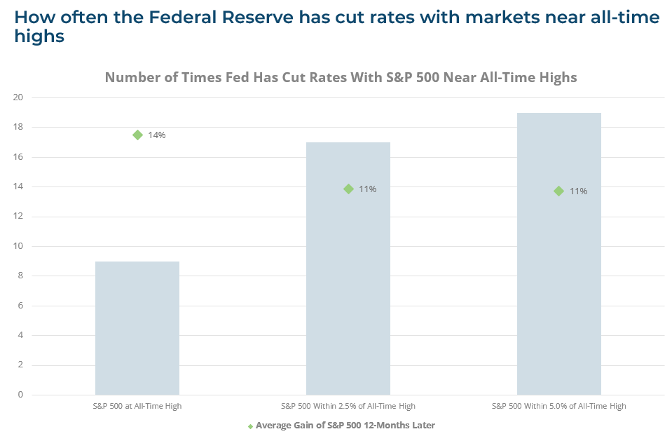
Source: Clearstead, Bloomberg LP, S&P 500 price return (1928-2025), Federal Funds Rate (lower bound). Data as of 7/16/2025, Past performance is not an indicator of future results.
[1] US Federal Reserve Act of 1913 (https://www.federalreserve.gov/aboutthefed/fract.htm) Banking Act of 1933; Federal Reserve Act of 1977.
[2] “Is the Federal Reserve Overstaffed or Overworked? Insights from the Fed’s Financial Statements,” Andrew Levin, March 2025, Mercatus Center George Mason University.
[3] Bloomberg LP, as of 8/1/2025.
[4] Clearstead, Bloomberg LP, S&P 500 price return (1928-2025), Federal Funds Rate (lower bound). Data as of 7/16/2025, Past performance is not an indicator of future results.
The views and opinions expressed in this article are solely those of the author and do not necessarily reflect the position of The Truth About Your Future or its affiliates. This content is provided for educational and informational purposes only and does not constitute investment, financial, legal, tax, or accounting advice, nor an offer, solicitation, or recommendation to buy or sell any security or other asset. Information is current as of the date of publication and may become outdated; no representation is made as to its accuracy or completeness. Publication does not constitute an endorsement of the author, the author’s firm, or any product or service referenced, and the author may hold positions in the assets discussed. Readers should consult their own qualified professionals before making any financial decisions.
Information provided in this article is general in nature, is provided for informational purposes only, and should not be construed as investment advice. These materials do not constitute an offer or recommendation to buy or sell securities. The views expressed by the author are based upon the data available at the time the article was written. Any such views are subject to change at any time based on market or other conditions. Clearstead disclaims any liability for any direct or incidental loss incurred by applying any of the information in this article. All investment decisions must be evaluated as to whether it is consistent with your investment objectives, risk tolerance, and financial situation. You should consult with an investment professional before making any investment decision. Performance data shown represents past performance. Past performance is not an indicator of future results. Current performance data may be lower or higher than the performance data presented.
NOTE: Unless otherwise mentioned, all graphics on this website pertaining to articles are licensed and owned by THETAYF. This website owns all of these images.