

What 12,000 Advisor Conversations Reveal About Better Advice
By Rick Lake, CAIA, CETF, CBDA | Founder, Narrative Alpha
August 21, 2026

AI-generated illustration created by Narrative Alpha.
AI finally opened the black box of the client meeting. What’s inside should change how you run your practice.
The ancient Greeks sang their stories for centuries before anyone thought to write them down. Now we watch them on IMAX.
What do advisors say to their clients? Until now, that was a guess.
But thanks to AI, we don’t have to wait centuries for an industry-encompassing answer. The results have been published, and you don’t need an IMAX screen to see them.
The insights team at Jump, led by Liam Hanlon, ran conversational intelligence across a full year of advisor-client meetings: 12,000 in all from November 2024 to October 2025, of which roughly 9,700 passed their quality screens. Data from participating firms provided the raw material, with every conversation irreversibly anonymized through Jump’s Privacy-Preserving Pipeline before analysis, according to the report. Natural-language queries turned each meeting into statistics on sentiment, fears, life events, planning topics, and investments. Liam and his team went full quant on the data, and published a methodology appendix to keep the harumphing to a minimum.
You can read the results in Jump’s 2026 Financial Advisor Insights Report. The first finding is about advisors, not clients. Get ready: it stings.
Revelation #1: Advisors talk more than they realize
The gap between what advisors believe about their meetings and what happens in them is wide enough to measure with GPS rather than a ruler.
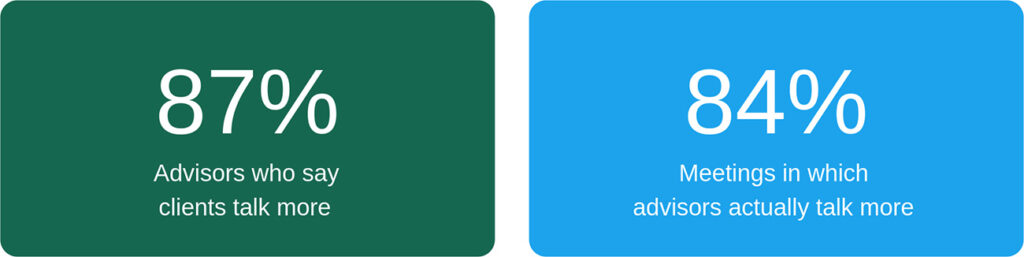
A Horsesmouth survey cited in the study found that 87% of advisors said clients spoke more during meetings. The transcripts found nearly the reverse.
Advisors spoke more than clients in 84% of meetings.
What Advisors Think Happens vs.
What the Data Shows
Source: 2026 Financial Advisor Insights Report, p. 4
Advisors have real reasons to talk. A client asks whether “Liberation Day” tariffs should change anything, and the honest answer burns the clock. Tax and estate plans have many moving parts. A portfolio rebalancing needs a full explanation before the client can sign off. Expertise has to be communicated, and an advisor who cannot explain the plan is not much use.
But the meeting has a way of turning into the explanation. An advisor goes full CFP on a question the client asked casually, and the hour fills with competence.
Once, I sat with a widowed client and delivered a clinic on multi-generational wealth transfer: the complete strategy, the whole architecture, with tax optimization and alternative investments. It was good work. I knew the material cold.
But the client was waiting for me to stop so they could tell me what their departed spouse would have said about it all.
I didn’t see that coming. Their emotional words stopped me in my technical tracks. I only began to understand the exchange on the long drive home. Call it encyclopedia-in-mouth disease. The tell: symptoms increase after the meeting ends.
The comparison raises a question worth some self-reflection. How much of the meeting is being used to explain, and how much is being used to find out what the client is actually thinking and feeling?
The rest of the report suggests the answer matters more than most advisors would guess.
Revelation #2: The outside world enters the meeting
The study period was a noisy one, and the noise carried into the room.
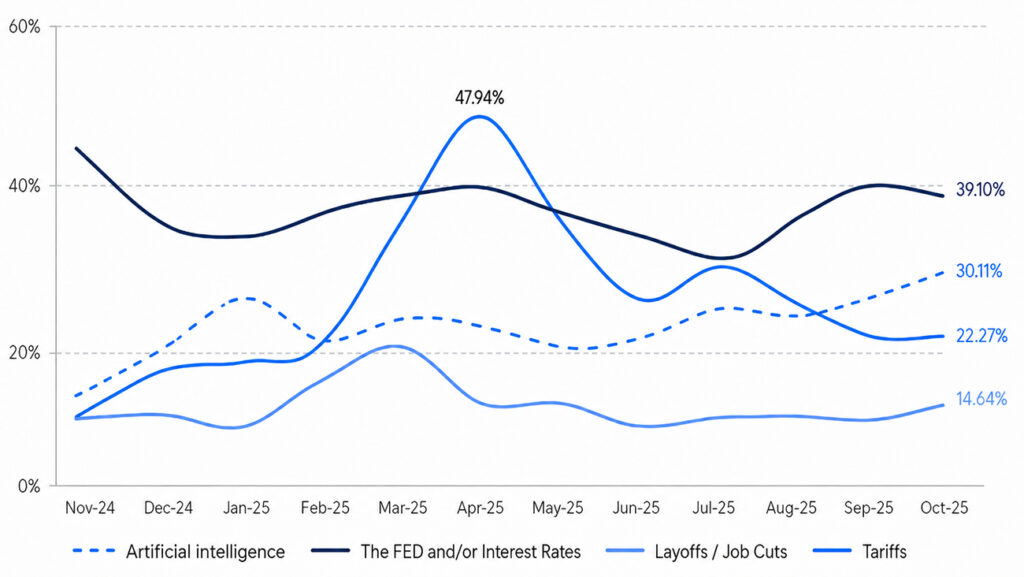
- Tariff discussions hit 47.94% of meetings in April 2025.
- Fed policy and interest rates were a persistent presence, appearing in 42.46% and 39.10% of conversations in November 2024 and October 2025, respectively.
- Layoffs and job cuts ticked above 20% in March.
- AI talk roughly doubled during the period, from 15.64% to 30.11%.
Extra Guests: The World Enters Your Client Meetings
% of Meetings Discussing Key Macro Topics, by Month
Source: 2026 Financial Advisor Insights Report, p. 26. Chart redrawn by the author from the published version.
Some macro topics could also carry a cost. Meetings that touched upon them were modestly but consistently more likely to end with client sentiment lower than it started. The outside world sometimes made meetings harder.
Source: 2026 Financial Advisor Insights Report, p. 27
Who raised the subject changed the impact. Client-initiated macro discussions produced stronger sentiment improvements than advisor-initiated ones. When advisors introduced the outside world, the sentiment of the meeting was not improved as much.
The opening minutes are worth guarding. An advisor who leads with employment stats, DC, or AI may be answering a question the client had not gotten around to asking.
On macro topics, the report concludes that letting clients set the framing kept conversations on more stable emotional ground. A simpler opening could leave room for that:
What has changed since we last spoke?
The answer may go straight to markets. Or somewhere else entirely.
Revelation #3: Fear is a regular participant in client meetings
Almost half of all meetings, 48.26%, included at least one stated client fear.
Fear also rarely showed up alone. About 23% of meetings contained a single fear, 12% contained two, and nearly 14% contained three or more. More than a quarter of all client meetings carried multiple expressed worries at once.
Fear is Common, and Often Comes in Clusters

Source: 2026 Financial Advisor Insights Report, p. 8
The views and opinions expressed in this article are solely those of the author and do not necessarily reflect the position of The Truth About Your Future or its affiliates. This content is provided for educational and informational purposes only and does not constitute investment, financial, legal, tax, or accounting advice, nor an offer, solicitation, or recommendation to buy or sell any security or other asset. Information is current as of the date of publication and may become outdated; no representation is made as to its accuracy or completeness. Publication does not constitute an endorsement of the author, the author’s firm, or any product or service referenced, and the author may hold positions in the assets discussed. Readers should consult their own qualified professionals before making any financial decisions.